
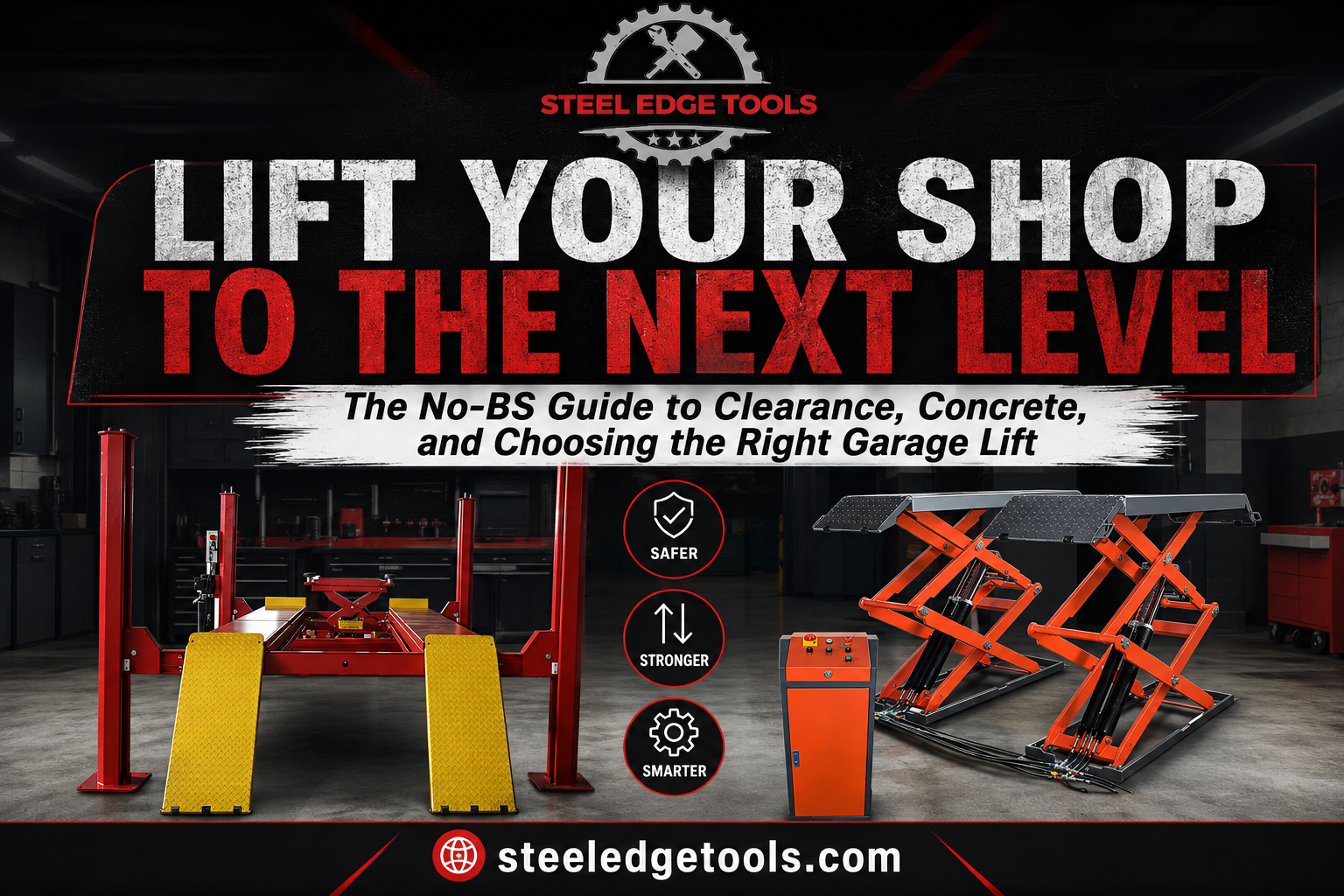
For a home mechanic or car collector, replacing jack stands with an overhead hoist can transform the garage. A home garage car lift improves working access and can reclaim valuable floor space. The wrong setup, however, can lead to costly concrete or clearance problems.
Before you buy a garage lift, evaluate ceiling height, slab specifications, vehicle weight, lift style, power, and installation needs. Visit Steel Edge Tools for high quality residential garage lifts.
Decoding the Types: Which Garage Lift Fits Your Shop?
2-Post Lifts: Best for wheel-off maintenance
A 2-post design is ideal for brake work, suspension service, exhaust repairs, and jobs where the wheels need to hang free. It supports the vehicle at designated lifting points, leaving strong underbody access. Because posts transfer concentrated loads into the floor, anchoring deserves close attention. Steel Edge Tools lists 2-post models from 9,000 to 12,000 lb capacities, with individual product specifications defining installation conditions.
4-Post Lifts: Stability and storage
A 4-post configuration supports the vehicle on runways, making it useful for storage, quick maintenance, and stacking one vehicle above another. It is a strong choice when stability and parking flexibility matter most. Some models also offer caster kits and jack-tray accessories. Steel Edge Tools carries multiple 4-post options. Check Out Our Complete Garage Lift Collection at Steel Edge Tools.
Scissor & Portable Lifts: When space is tight
Scissor and portable systems can work when a full-height post arrangement will not fit. Mid-rise products can also be moved when a bay serves multiple purposes. Compare lifting height and side access carefully.
Crucial Pre-Purchase Checklist: Ceiling Height & Floor Specs
The Ceiling Math
A useful planning formula is:
Vehicle height + required lift height + 6 inches of practical clearance = target minimum ceiling height.
Treat this as a planning rule, not a universal specification. Actual requirements depend on lift height, vehicle roof height, and overhead obstructions.
If you are researching the minimum ceiling height for garage lift, measure the lowest obstruction, not simply the peak of the roof. A pickup with a bed rack or tall SUV can change the calculation. Steel Edge Tools lists low-profile products.
Concrete Thickness Requirements
Do not assume every slab is suitable. Some manufacturers specify a 4-inch, 3,000 PSI slab, while other heavy-duty models require more. Steel Edge Tools documentation shows one 4-post model requiring at least 3.93 inches and 3,000 PSI, while a 12,000-lb 2-post model specifies at least 5.9 inches and 3,000 PSI.
The product manual must control your installation decision. Before drilling, verify slab thickness, strength, cracks, reinforcement, and local requirements. If the floor does not meet specifications, get qualified structural guidance instead of improvising.
Power Supply Needs
Electrical requirements vary. Some portable and mid-rise products are offered in 110V configurations, while heavier two-post systems may use 220V single-phase power. Have a qualified electrician verify voltage, breaker sizing, wiring, grounding, and local code requirements before installation.
Top Features to Look for Before You Buy
Safety Lock Systems
Mechanical locks are essential to safe lifting. Look for automatic locking positions, clear release procedures, and redundant safety features. Steel Edge Tools models include manual single or dual-point releases, while certain 4-post products use multiple mechanical locking devices. Never rely on hydraulic pressure alone to hold a raised vehicle.
Weight Capacities
Your residential automotive lift capacity should exceed the actual loaded weight of the heaviest vehicle you expect to raise. Do not choose based only on curb weight; fuel, passengers, tools, accessories, and cargo add mass. A 7,000-lb rating may suit many cars and lighter SUVs, while 10,000 lb or higher may make sense for heavier trucks, provided the floor, lift geometry, and adapters are appropriate.
Arm Extensions & Adapter Heights
Low-profile cars need correct lifting-point reach and adequate adapter height. Stackable pads and extensions can accommodate different chassis heights, but use them exactly as specified. Confirm that arms clear rocker panels and adapters contact approved lifting points without damaging frame rails.
2-post vs 4-post lift for home garage
The decision comes down to how you work. Choose two posts when wheel-off access and underbody service are the priority. Choose four posts when stability, vehicle storage, and straightforward drive-on positioning matter more.
If headroom is limited, the best car lift for low ceiling garage applications may be a low-profile 2-post, mid-rise, or scissor design. Compare lowered height, maximum rise, and obstruction profile, not just the lift category.
How to Get Your Shop Ready for Installation
Start with a layout. Mark the vehicle centerline, lift footprint, garage-door tracks, opener, lighting, and walking paths. Confirm doors can open without contacting the equipment and that the vehicle can enter and exit squarely.
Plan delivery too. Heavy lifts can arrive by freight on large pallets, so confirm unloading requirements, staging space, and driveway-to-garage access.
For garage vehicle lift installation, follow the exact manufacturer manual, use specified anchors and tools, and verify every dimension before drilling. If concrete or structural conditions are uncertain, consult a qualified professional. Discover Our Complete Garage Lift Collection at Steel Edge Tools.
Upgrade Your Workspace Today
A quality garage lift can make maintenance accessible while turning vertical space into storage or parking capacity. The key is buying around the garage you actually have, not the garage shown in a product photo.
Ready to compare options? Visit Steel Edge Tools to find the right garage lift for residential and commercial choices, and review capacity, dimensions, concrete requirements, power configuration, and safety features before ordering.
FAQs
1. What should I check before buying a garage lift?
Measure ceiling height, vehicle height, floor condition, bay width, electrical supply, and rated capacity. Compare everything with the manufacturer's specifications.
2. Can I install a vehicle lift on any concrete garage floor?
No. Requirements vary by model. Some specify 3,000 PSI concrete and around four inches of thickness, while heavier models may require more. Cracks, joints, reinforcement, and curing can also matter.
3. Is a two-post or four-post lift better for home use?
Neither is universally better. Two-post designs favor service access; four-post designs favor stability, storage, and drive-on positioning. Your maintenance habits should decide.
4. How much weight should my lift support?
Select a capacity above the heaviest fully loaded vehicle you will lift. Follow the manufacturer's rated capacity and lifting-point requirements.
5. Do I need a professional to install a lift?
Professional installation is prudent when concrete, anchoring, electrical work, or structural questions are involved. Always follow the manufacturer's installation instructions.
6. Can a low-ceiling garage use a vehicle lift?
Yes. Low-profile two-post, mid-rise, and scissor products can provide useful lifting with less overhead clearance.
Conclusion
The best garage lift is the one that matches your vehicles, concrete, ceiling, electrical system, and maintenance needs. Measure first, verify requirements, plan carefully, and choose adequate capacity. With that groundwork complete, a lift can become one of the most valuable upgrades in a well-equipped home garage. Discover quality vehicle lifting equipment at Steel Edge Tools and shop our complete garage lift collection to choose the right solution for your garage and automotive needs.
Steel Edge Tools
- Phone: +1 (800) 960-5329
- Email: support@steeledgetools.com
- Address: 7924 Preston Road, Plano, Texas, 75024, USA